Reading time: 16 min
The Necessity of Paying Attention to Water Hammer: The Importance of Water Hammer and the Need to Address It
1-Introduction to Water Hammer
Water hammer, also known as hydraulic shock, is a physical phenomenon. It occurs when the flow of fluid in a piping system changes suddenly, for example when a valve closes or a pump shuts down.
This creates a strong pressure wave in the system that can damage pipes and fittings. Water hammer can lead to leaks, pipe fractures, and even more widespread failures. Understanding this phenomenon and adopting effective approaches to reduce it is especially important in order to prevent structural damage and rising maintenance and repair costs.

2-Definition and Overview
Water hammer, also known as hydraulic shock, is a physical phenomenon. It occurs when the flow of fluid in a piping system changes suddenly, for example when a valve closes or a pump shuts down.
This creates a strong pressure wave in the system that can damage pipes and fittings. Water hammer can lead to leaks, pipe fractures, and even more widespread failures. Understanding this phenomenon and adopting effective approaches to reduce it is especially important in order to prevent structural damage and rising maintenance and repair costs.
3-Historical Background of Water Hammer
Attention to water hammer dates back to the early development of piping systems, when engineers first faced the unintended consequences of sudden valve closures and pump stoppages. Over time, with advances in hydraulics and fluid dynamics, our understanding of water hammer and the methods for countering it has evolved.
In the 19th century, as piping systems came into wider use for water distribution and wastewater collection in cities and villages, the importance of managing water hammer became well recognized. As a result, managing hydraulic transients became a fundamental priority. Numerous studies and experiments were carried out to find ways to prevent and reduce its effects, leading to solutions such as air chambers, pressure-reducing valves, and automatic control systems.
Today, with advances in technology and materials, we are able to deal with this phenomenon more effectively. Even so, understanding and addressing water hammer remains highly important in order to protect the health and safety of piping systems, transmission lines, and pumping stations.
In other words, engineers have been dealing with water hammer for more than a century, but today they have more advanced tools to control it.
4-The Basis of Water Hammer Knowledge
The science behind this phenomenon rests on the law of energy conservation and on fluid dynamics. When the flow of a fluid is suddenly stopped, its kinetic energy must be converted into another form, which in this case appears as a pressure wave. This pressure wave can place stress on pipes, valves, and other system components, and if the design is inadequate, it may cause serious damage.
Several factors influence the severity and risk of water hammer, including the fluid's flow velocity, its physical properties, the length and diameter of the pipes, and the way control equipment such as valves and pumps operates. Understanding these factors and implementing appropriate design strategies can help manage water hammer effectively. Such strategies include using surge dampers (surge tanks and similar devices), adjusting the operating speed of valves and pumps, and using pressure-resistant materials and structures.
In short, the science behind water hammer shows the importance of careful design and of applying intelligent engineering strategies to prevent and manage this phenomenon in piping systems.
5-Physics of Water Hammer
The physics of water hammer is rooted in the basic principles of fluid dynamics. When the flow of fluid in a pipe changes suddenly because a valve closes or a pump shuts down, a pressure is created in the system that can be much higher than the normal operating pressure. This additional pressure, known as water hammer, can propagate rapidly along the pipes and cause damage or even fracture.
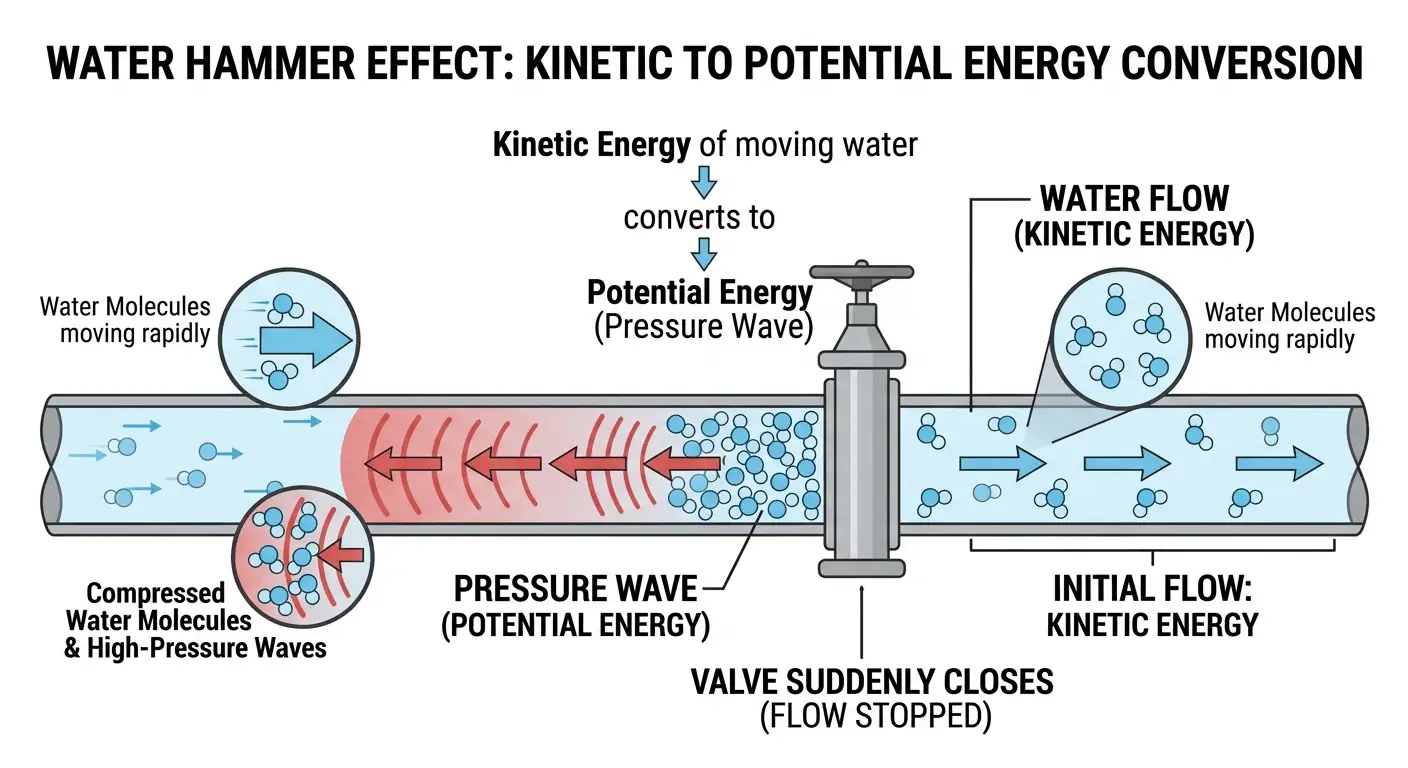
The phenomenon arises from the law of conservation of energy, which states that energy is neither created nor destroyed but only converted from one form to another. In the case of water hammer, the kinetic energy of the flowing fluid is suddenly converted into potential energy (additional pressure). If this sudden pressure change is not properly managed, it can seriously damage the system.
6-Factors Influencing Water Hammer
Several key factors can influence the severity and impact of water hammer:
Flow velocity: The higher the fluid velocity in the pipe, the more kinetic energy is present when a valve closes or a pump stops, and the more of it can be converted into water hammer pressure.
Fluid type and properties: The physical properties of the fluid, such as density and the coefficient of expansion (compressibility), can affect the magnitude of the water hammer pressure.
Pipe length and diameter: A longer pipeline and a smaller pipe diameter can increase the effects of water hammer, because there is a longer path for the pressure to propagate.
The way a valve closes or a pump stops: The speed at which valves close or pumps shut down also affects the severity of water hammer. Sudden valve closure or rapid pump stoppage can create higher water hammer pressure.
Pipe material and properties: The strength and flexibility of the materials the pipes are made from can also play a role in reducing or intensifying the effects of water hammer.
Understanding these factors and their influence on water hammer is the basis for designing and implementing effective strategies to manage and reduce the effects of this phenomenon in piping systems.
7-Consequences of Ignoring and Underestimating Water Hammer
Ignoring the importance of water hammer can have serious consequences for piping systems, for the safety of personnel and residents, and for the economy. Here we examine the various consequences of neglecting this phenomenon.
Structural Damage
Water hammer can cause serious damage to the physical structure of piping systems. This damage includes fractures and cracking of pipes, collapse (crushing) of pipes, failure of valves and fittings, and even the complete detachment of sections of the system. Such failures not only disrupt the system and interrupt services, but repairing them is also costly and time-consuming.
Safety Hazards
In addition to material damage, water hammer can create significant safety hazards. The excess pressure caused by water hammer can lead to water or other liquids spraying out and flooding indoor and outdoor spaces, which in turn increases the risk of slipping and falling for people nearby. Moreover, when systems containing hazardous liquids suffer water hammer, there is a risk of hazardous material leaks, with environmental and health impacts.
Economic Losses
The economic effects of water hammer can include both direct and indirect costs. Direct costs include repairing and replacing the damaged parts of the piping system. Indirect costs can include lost revenue due to halted production or water service, legal costs if property or third parties are harmed, and increased insurance costs. In addition, damage to reputation and public trust resulting from violations of safety standards can have long-term effects on organizations and companies.
Overall, addressing water hammer and taking preventive measures to manage it is extremely important in order to prevent structural damage, safety risks to people, and economic losses.
8-Preventive Measures Against Water Hammer
To reduce and manage the effects of water hammer and prevent the damage it causes, it is essential to adopt preventive measures and effective design strategies. In this section, we review some of these approaches.
Design Strategies
The first step in preventing and managing water hammer is adopting appropriate design strategies. This includes accurately calculating pressure and flow in the piping system, selecting suitable materials for pipes and fittings, and designing the pipe route in a way that avoids conditions prone to water hammer. The use of fluid flow simulation software can be helpful here, enabling engineers to identify potential weak points in the design before the project is built.
Pressure Vessels and Pressure Control Valves
The use of pressure vessels and pressure control valves can help reduce the effects of water hammer. Surge vessels act as dampers that can absorb and manage the excess pressure created by water hammer. Pressure-reducing valves, on the other hand, can automatically control the fluid flow to prevent sudden pressure increases. Using valves with slow, controlled closing times can also be useful in reducing the effects of water hammer.
Pump and Pipe Selection
Careful selection of pumps and pipes (material and diameter) also plays an important role in preventing water hammer. Pumps with speed control capability (such as variable frequency drive pumps) can help reduce the chance of water hammer, because they allow the flow velocity to decrease gradually. It is also essential to select pipes with suitable strength and flexibility to withstand the excess pressures and negative pressures resulting from water hammer. Using pipes of appropriate diameter and materials capable of absorbing pressure-induced stresses can be very effective in reducing the destructive effects of water hammer.
In short, preventive measures against water hammer involve a comprehensive, multi-dimensional approach that requires attention to design details, selection of suitable equipment, and the use of pressure-mitigating technologies. By implementing these strategies, many of the damages and hazards caused by water hammer can be avoided.
9-Detection and Diagnosis of Water Hammer
Timely and accurate detection of water hammer in piping systems is especially important, because it makes it possible to take countermeasures before serious damage occurs. In this section, we review the warning signs and the technologies used to identify water hammer.
Identifying the Signs of Water Hammer
The signs of water hammer may be detectable physically and audibly. Some common signs include the following:
Banging and harsh noises: Sudden, loud sounds in the piping system, sometimes resembling hammer blows.
Vibration of pipes and fittings: Unusual vibration in pipes and fittings, especially after rapid valve closure or sudden pump stoppage.
Leakage or damage at connections: Leaks at fittings, or physical damage such as cracking or fracturing of pipes caused by high pressure.
Detection Tools and Technologies
For more accurate and effective detection of water hammer, advanced tools and technologies can be used. These include:
Pressure sensors: Installing pressure sensors at key points of the piping system to monitor pressure changes and detect sudden fluctuations that may indicate water hammer.
Remote monitoring systems: Using IoT technologies and remote supervisory and telemetry systems to continuously monitor piping systems and send immediate alerts when water hammer is detected.
Acoustic data analysis: Using advanced algorithms to analyze acoustic data collected from the piping system in order to identify the sound patterns caused by water hammer.
Analytical and simulation software: Using engineering software to simulate the performance of piping systems and predict the likelihood of water hammer under different operating conditions.
Using these tools and technologies can help manage piping systems better and take immediate action to prevent damage caused by water hammer. This proactive approach not only helps maintain the health of the system but also prevents widespread damage and the maintenance and repair costs that come with it.
10-The Role of Technology in Water Hammer Management
Technology plays a key role in identifying, managing, and reducing water hammer in piping systems. Using recent advances in simulation and modeling and in smart monitoring systems, engineers can accurately assess system performance before problems occur and take preventive action.
Advances in Simulation and Modeling
Advanced simulation and modeling software makes it possible to model piping systems accurately and predict their behavior under different conditions. These tools allow engineers to predict the effects of water hammer at the design stage and to implement solutions to reduce those effects, such as determining the best location for installing dampers or adjusting the piping layout.
This software can also help optimize pumping operations and pressure control in complex systems so that the risk of water hammer is minimized.
Smart Monitoring Systems
Smart monitoring systems, often implemented using Internet of Things (IoT) technology, help collect real-time data from piping systems. These systems can include pressure, flow, and temperature sensors that continuously collect data and send it to a data center for analysis.
By analyzing this data, early signs of abnormal pressure changes that may indicate a risk of water hammer can be identified. This allows system management to react quickly and take the necessary action to prevent damage or reduce losses.
Advanced monitoring and simulation technologies significantly improve the safety and efficiency of piping systems. By implementing these technologies, many problems caused by water hammer can be prevented, helping ensure uninterrupted and safe system operation.
11-Future Outlook for Water Hammer Management
With the growing focus on sustainability and environmental protection, future trends in water hammer management are moving toward green solutions and innovations in materials science. These changes not only help reduce negative environmental impacts but also improve the efficiency and safety of piping systems.
Sustainable and Green Solutions
One of the key trends in water hammer management is the development and implementation of solutions with minimal negative environmental impact. This includes using environmentally friendly materials and technologies for building and maintaining piping systems.
For example, this includes developing lightweight, efficient pressure vessels made from recycled or recyclable materials, which have the least impact on the environment. In addition, using renewable energy to operate pumping and pressure control systems can make a significant contribution to reducing carbon emissions.
In practical terms, protection against water hammer is no longer only about safety; it is also about sustainability.
Innovations in Materials Science
Advances in materials science play a vital role in developing innovative solutions to counter water hammer. New materials with improved properties, such as higher flexibility, greater pressure resistance, and longer service life, can significantly reduce the vulnerability of piping systems to water hammer.
These new materials include advanced polymers, composites, and nano-reinforced materials, which can be specifically designed and manufactured to reduce the effects of water hammer.
In addition, research is under way on smart and self-healing materials, solutions that can automatically repair damage caused by water hammer, which could help reduce maintenance costs and extend the life of piping systems.
Future trends in water hammer management reflect continuing efforts to find sustainable and efficient solutions that not only help protect piping systems but are also committed to preserving the environment and natural resources.
12-Practical Example of Water Hammer Management
Some managers and experts regard pipeline rupture incidents as natural. One example is the rupture of the Taleghan Dam–Tehran water transmission pipeline in the Kamalshahr area of Karaj, which occurred in 1390 (Iranian calendar, around 2011). A summary of the news report is as follows:
“Ali Asghari told an IRNA reporter on Tuesday: this rupture occurred at around 7 a.m. today in the 1800 mm pipeline carrying water from Taleghan Dam to Tehran, at Kamalshahr in Karaj. He noted that personnel of the Tehran Regional Water Authority brought the rupture under control within two hours.
He said the maximum water transmission capacity of this line is five cubic meters per second. Asghari added that the causes of the two ruptures of this pipeline, in the Rajaei Shahr and Kamalshahr areas of Karaj, are under investigation.
The Taleghan Dam–Tehran water transmission line had also ruptured last week in the Rajaei Shahr area of Karaj, causing damage. He said this incident is among those that often occur in water pipelines and is not unexpected.
He added that as a result of the rupture, floodwater flowed in the Kamalshahr area, and the Robat Machine factory and two passenger cars were flooded. Asghari stated that experts are now assessing the amount of water loss and the damages incurred.
He added that Tehran Regional Water Company, the Kamalshahr municipality, firefighting and rescue forces, the Red Crescent, and the police cooperated in bringing the incident under control.”
As the news report shows, the responsible official regarded the occurrence of incidents in water pipelines as natural and did not consider it unexpected. However, according to the technical investigations carried out by this company's experts on the Taleghan Dam–Tehran water transmission line, the cause of the incident was the sudden closure of the on-off valve at the end of the transmission line.
The float valve at the tank inlet was rusted and closed suddenly. As a result, water hammer occurred along the route, to the extent that the pressure at the rupture point exceeded 40 bar, while the pipe's tolerance was 16 bar, and the pipe burst at the weld.
This means that if the water hammer calculations had been carried out accurately, the necessary provisions would have been made at the point of maximum pressure. Likewise, if the valve at the end of the line had been selected based on the water hammer calculation results, and valve repair and maintenance had been fully carried out, this incident would not have happened in this way.
In fact, the occurrence of an incident on a transmission line is not always natural and normal. It is often a sign that engineering and technical principles have not been observed, one of the most important of which is examining the water hammer phenomenon.
Incidents of this kind on fluid transmission lines, especially water lines, and the sometimes considerable damage they cause, in themselves demonstrate the importance of examining and addressing water hammer. This should be done by skilled and experienced experts, based on the latest standards and methods available.
13-Conclusion and Summary
In this article, we provided a comprehensive review of the water hammer phenomenon, its effects on piping systems, detection and diagnosis methods, preventive measures and mitigation strategies, along with the role of modern technologies in managing this challenge. The importance of addressing water hammer and adopting effective approaches to counter it has become clearer than ever, especially in light of recent advances in materials science and technology.
Summary of key points:
- Water hammer can lead to serious structural damage, safety hazards, and economic losses.
- Timely detection and diagnosis, together with preventive and mitigation measures, are essential for managing the effects of water hammer.
- Advanced technologies such as smart monitoring systems and simulation software play a key role in predicting and countering water hammer.
- Future trends will focus more on sustainable and green solutions and on innovations in materials science.
14-Professional Water Hammer Engineering and Consultation
Kavir Engineering Group, known as a leading company in the design and manufacture of water hammer control equipment, offers unique opportunities for innovation and for delivering advanced engineering solutions.
The time has come to use technical knowledge and new technologies to move toward improving the safety and efficiency of piping systems.

To advance the sustainability and safety goals of your piping systems, now is the time to join the leaders of the water industry and benefit from innovative technologies in water hammer management.
With years of experience in designing and manufacturing advanced water hammer control equipment, Kavir Engineering Group is committed to delivering engineering solutions in line with the latest technical and environmental standards.
We invite you to contact us and receive specialized consultation. Our experts are ready to identify your specific needs and offer the best and most effective solutions for reducing the risks of water hammer in your piping systems.
Joining Kavir Engineering Group is a firm step toward intelligent and sustainable water hammer management.